In most U.S. contexts, transit improvements rely on public investment and produce private value, which could be recaptured by the public investors
|
Transit improvements generate real estate value in surrounding areas. Due to the improvements, nearby landowners may see their operating income rise and they may garner more profit upon the sale of their property. Because of this symbiotic relationship, there is a long history of cooperation between private real estate interests and transit providers, including the private provision of transit services.
However, it has become more common for transit systems - expensive pieces of complex infrastructure - to be built and operated by the public sector utilizing substantial federal, state, and local government subsidies. Financial support for transit from real estate interests has become the exception rather than the rule. Landowners, property operators, and real estate developers commonly experience windfall gains from public investments in transit while transit operators struggle to fund capital and service improvements. While there are modern instances when public transit providers have shared in the value uplift that otherwise accrues to private real estate interests, there are many more missed opportunities for public transit providers to capture some of the private real estate windfall that transit generates. Capturing the value could help fund more transit system construction and improved operating performance or be used to offset public subsidies, all while reigniting the symbiotic relationship that can exist between transit and real estate interests. |
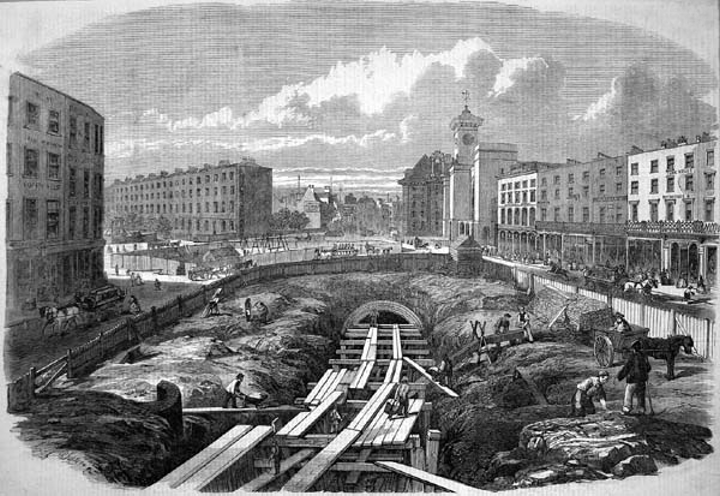
"Constructing the Metropolitan Railway" by P Justyne
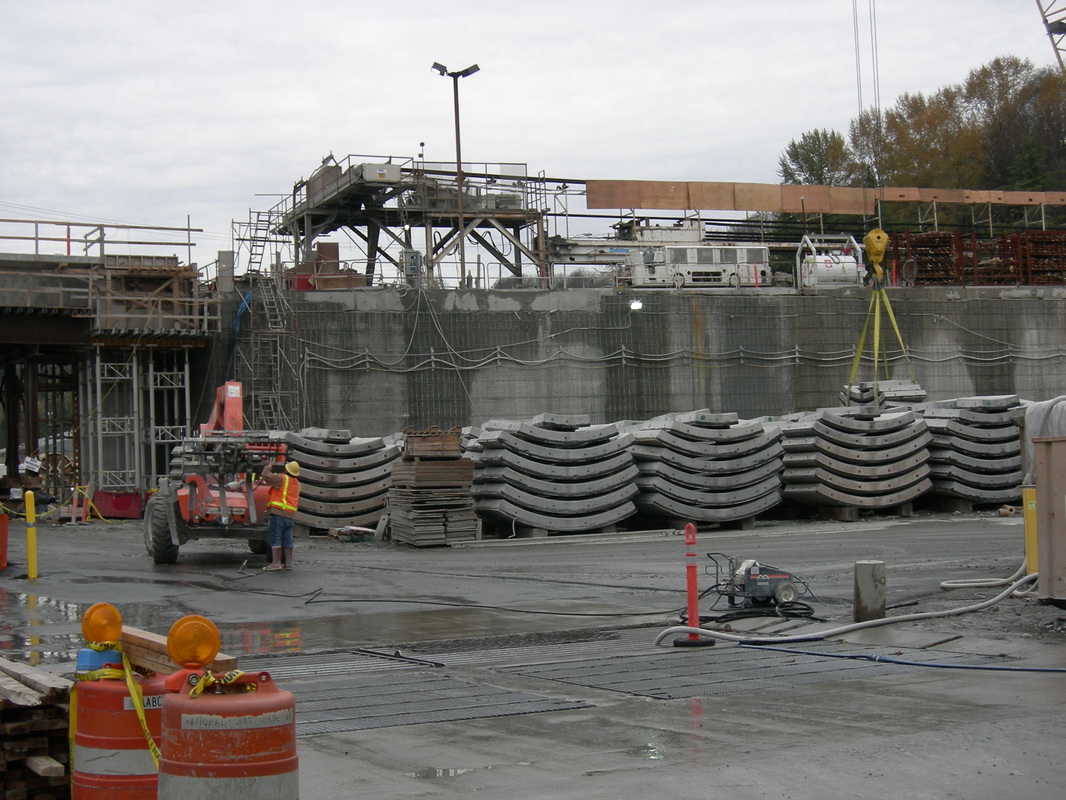
"Sound Transit light rail under construction" by Joe Mabel
|
What is transit value capture?
Value capture is a type of public financing that recovers some or all of the value that public infrastructure generates for private landowners. Public infrastructure includes sewers, streetscapes, underground power lines, traffic lights, noise barriers, and any number of other public investments - including transit. The term "value capture" is broadly applicable to an array of mechanisms that can capture value from private real estate interests. And the value that is recovered by the public can be used as the public sees fit. In many instances, the implementation of a value capture mechanism is justified by the real estate value uplift directly attributable to the infrastructure improvement and the revenues from the value capture mechanism are used to offset the cost of implementing that public infrastructure. However, that is not always the case.
|
Transit value capture is a specific instance of value capture. While definitions of transit value capture vary, a few widely appreciated themes persist:
|
|
Transit value capture occurs when landowners, property operators, or real estate developers benefit financially from transit services and those same real estate interests contribute some of those windfalls toward public investments.
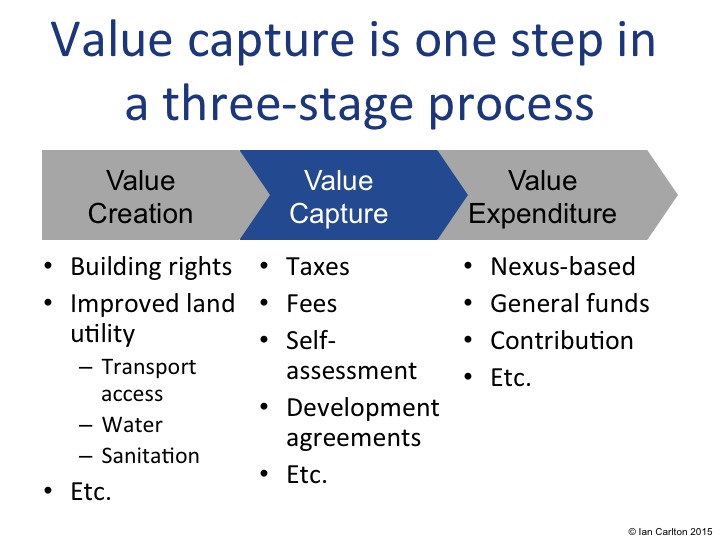
You'll note that my definition loosely describes the Value Creation process. A strict, classical definition of value capture might focus on real estate value created directly by public transit. However, the direct impact of transit on real estate value in the U.S. context can be small, which, if we focused on it exclusively, would leave us little to discuss and would ignore the tremendous value lift that can result indirectly from transit improvements. Furthermore, I believe that it is worth discussing many instances when value is created by private investment in transit, not just publicly operated transit. I suggest that transit value capture occurs when transit is improved by private parties, real estate value accrues privately, and part of the value uplift is used to fund the privately operated transit. I find that we foreclose worthwhile conversations when we limit the definition of transit value capture based on how real estate value is created or captured.
Also, I do not focus on how the value is expended. A strict, classical definition might focus on value expenditure that repays the public for its investment in the public infrastructure/expenditure/policy that initially created the value (e.g., repaying road bonds, replenishing the treasury's capital projects fund after a waterway is completed). However, this is not a pragmatic definition. For one, many of our value capture mechanisms yield funds for a government agency different from those government agencies responsible for funding, building, operating, and regulating the public investment that generated the value initially. Thus, the captured funds are expended on other public benefits that are also worthwhile, like affordable housing near transit. While this may not lead to an idealized virtuous cycle described by adherents to classical value capture, limiting the definition too much might leave us with little to discuss!
Also, I do not focus on how the value is expended. A strict, classical definition might focus on value expenditure that repays the public for its investment in the public infrastructure/expenditure/policy that initially created the value (e.g., repaying road bonds, replenishing the treasury's capital projects fund after a waterway is completed). However, this is not a pragmatic definition. For one, many of our value capture mechanisms yield funds for a government agency different from those government agencies responsible for funding, building, operating, and regulating the public investment that generated the value initially. Thus, the captured funds are expended on other public benefits that are also worthwhile, like affordable housing near transit. While this may not lead to an idealized virtuous cycle described by adherents to classical value capture, limiting the definition too much might leave us with little to discuss!
How do you capture the value of transit?
There are many ways to capture value. I consider value capture mechanisms to fall into three main categories.
Model Value CaptureI use the term Model Value Capture to describe mechanisms that specifically target the land value increment created by transit improvements and other public investments.
|
Common Value CaptureI use the term Common Value Capture to describe an array of mechanisms that impact real estate interests but do not specifically target the land value created by public investments. These mechanisms can be grouped by the primary real estate institution involved.
|
Other Value CaptureThere are other forms of value capture worthy of mention. These mechanisms do not clearly fit into either of the prior categories but can impact real estate interests and yield funds for the public sector.
|
What is the best value capture mechanism?
This question is one that I consider frequently. One way that I seek insights into this is by keeping track of transit value capture implementation across the country. This blog arose out of a desire to keep track of my thoughts on some of the most interesting case studies that I have encountered.
Through my observations, it is clear to me that the "best" means of capturing the value of transit varies by context and is a multifaceted, subjective concept. Among other factors, one must consider if mechanisms are legally enabled in a jurisdiction, whether they are applicable to particular transit services, if they are politically feasible to implement, and the value that can be captured relative to the risks associated with the mechanisms.
Ultimately, there is no guide book on selecting mechanisms because transit value capture must be approached in a thoughtful, context-sensitive, and political manner. As I identify any general rules, I'll be sure to blog about them! If you have questions or thoughts to add, please do not hesitate to contact me.
Through my observations, it is clear to me that the "best" means of capturing the value of transit varies by context and is a multifaceted, subjective concept. Among other factors, one must consider if mechanisms are legally enabled in a jurisdiction, whether they are applicable to particular transit services, if they are politically feasible to implement, and the value that can be captured relative to the risks associated with the mechanisms.
Ultimately, there is no guide book on selecting mechanisms because transit value capture must be approached in a thoughtful, context-sensitive, and political manner. As I identify any general rules, I'll be sure to blog about them! If you have questions or thoughts to add, please do not hesitate to contact me.
How should we expend the value that has been captured?
Most communities have long lists of worthwhile items that deserve funding. Depending on local enabling legislation and politics, value capture can fund many of these items. Typical value capture expenditures focus on a few items:
- Repaying bonds used to finance the construction of transit infrastructure or funding ongoing operations of the transit services that generate value
- Providing transit-oriented affordable housing through inclusionary requirements, land price write-downs, operating subsidies, or other means
- Transportation infrastructure serving station areas, like complete street improvements, bike facilities, consolidated parking facilities
- Mobility
- Pedestrian/Bicycle infrastructure
- Parking (simple provision/shift to deck from surface parking)
- Local shuttles
- Car/bike sharing facilities
- Equity
- Affordable housing
- Diversity programs
- Gentrification mitigation
- Environment
- Site remediation
- VMT reduction programs / Air quality programs
- Noise abatement
- Water resources
- Visual enhancements – e.g. façade enhancements
- Habitat preservation
- Public space
- Open/green space
- Watershed enhancements
- Recreation/active space
- Streetscape enhancements
- Trails
- Historic structure preservation
- Economic development
- Concentrating Green jobs
- Job training
- Small and minority-owned business assistance
- Education
- Facilities improvements
- Kindergarten / Daycare / After-school services
- Charter Schools and Magnet Schools
- Services
- Street/Sidewalk cleaning service
- Increased police patrols / Ambassador force
- Farmers markets
- Other social services
- Infrastructure
- Community facility construction
- Undergrounding utility lines
- Upgrading infrastructure